


“Clay is a dancer, viveur, playboy and a driver in his spare time.”
— Enzo Ferrari
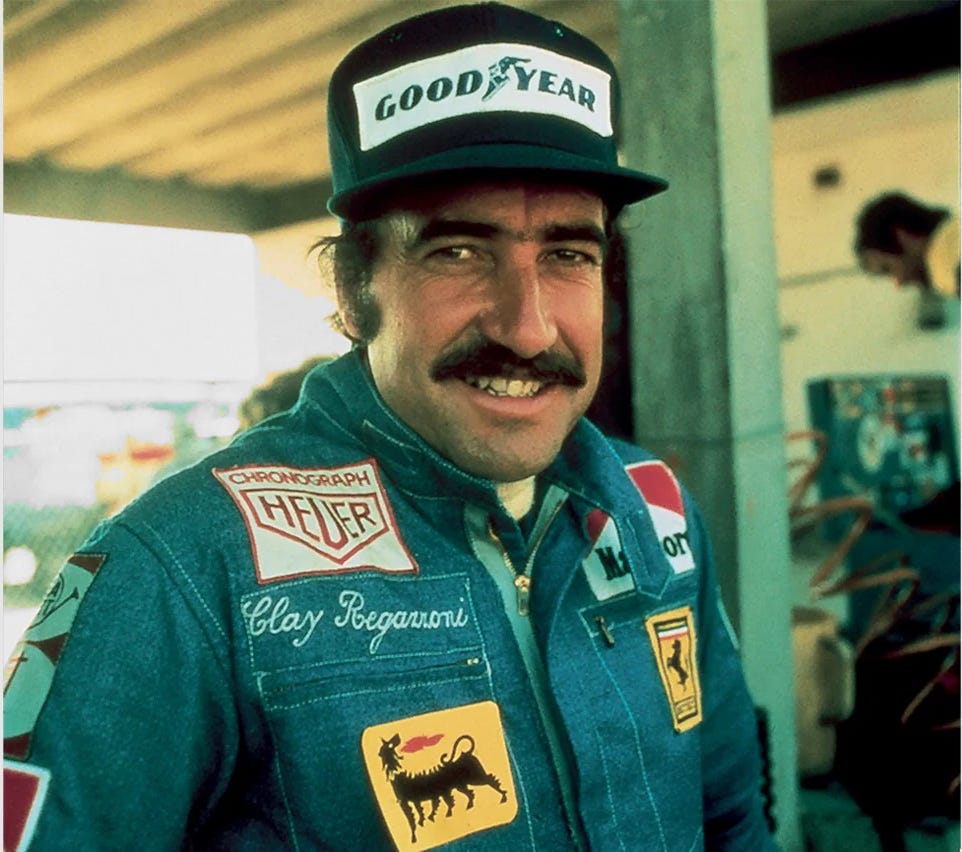
Exuberant yet disciplined, flamboyant yet astute, Gianclaudio “Clay” Regazzoni was a legendary Formula 1 driver for many race teams, including Ferrari and Williams.
In an era of Formula 1 when danger was woven into every lap, he chose not to retreat from it. He lived fast, survived the unsurvivable, and insisted that the race, in one form or another, would always continue.
Table of Contents: Early Years / Education / Racing Career / Formula One / Long Beach Accident / Post F1 Career / Books / Personal Life / Later Years
If you aren’t subscribed yet, hit the subscribe button below to receive the Adorable Stories every weekend, directly in your inbox:
Early Years
Gianclaudio Giuseppe “Clay” Regazzoni was born on September 5th, 1939, in Mendrisio, in Switzerland’s Italian-speaking canton of Ticino.
He grew up in nearby Porza, above Lugano: his father, Pio Regazzoni, was a skilled carrozziere — a master of automobile bodywork — and served for nearly three decades as mayor of Porza.
Clay had two brothers, Mario Angelo and Giordano, known as “Dodo,” who also briefly tried racing.
His father’s workshop was his first playground: amid welding sparks and dented fenders, Clay developed an instinctive understanding of how metal bends and how speed feels.
Years later, mechanics would marvel at his sensitivity to race cars chassis balance: that intuition was born on the concrete floor of his father “carrozzeria”.
The nickname “Clay” followed him from adolescence into legend.
Education
Clay attended school in Lugano but soon joined the family body shop.
Switzerland’s ban on circuit racing, imposed after the June 11th, 1955 catastrophe at the 24 Hours of Le Mans, shaped the geography of his ambition.
That late spring afternoon, Mercedes driver Pierre Levegh collided with an Austin-Healey. His car disintegrated at high speed, with its engine block and suspension components projected into the audience: Levegh was killed instantly, 83 spectators lost their lives and well over a hundred more were seriously injured.
